new homes already built for sale melbourne — by the end of this hands-on guide you will confidently locate, evaluate, finance and legally secure a move-in ready home in the Melbourne metro area. Expect to spend 2–8 weeks from search to settlement for most purchases; this guide assumes you have basic familiarity with property transactions and can commit to scheduled inspections, lender meetings and conveyancing tasks.
Before you start, gather the documents and tools below so you can act on opportunities quickly and avoid costly delays.
Before you start
- Proof of funds and pre-approval from your lender (allow 1–5 business days for pre-approval).
- Contact details for a conveyancer/solicitor and a certified building inspector.
- List of target suburbs, maximum budget, and must-have features (e.g., 3+ beds, garage, energy rating).
- Calendar availability for 2–3 property inspections per week.
- Notebook or digital tool for checklists and photos during inspections.
Introduction to New Homes Already Built for Sale in Melbourne
This guide focuses on practical steps for buying move-in ready homes Melbourne buyers can occupy immediately. You’ll learn which suburbs currently list the best value brand new houses for sale in Melbourne, how to separate genuinely finished homes from display or near-complete builds, and the negotiation and financing moves that close transactions reliably.
If you want design context as you choose finishes or evaluate builders’ inclusions, see our modern house design guide for contemporary style and planning principles that pair well with new builds.
Transition: next, we evaluate why buyers choose finished new builds rather than other housing options.
Why Choose New Homes Already Built? Benefits and Drawbacks
- Benefits — Quick move-in and modern features:
- Immediate occupancy: move-in ready homes typically allow possession within 2–6 weeks after contract exchange and settlement (depending on lender and vendor timelines).
- Contemporary inclusions: built-in appliances, LED lighting, high-efficiency hot water systems and higher standard insulation, reducing initial upgrade costs.
- Reduced maintenance in early years: new materials and warranties mean lower maintenance expense — often 0–2% of property value annually in first five years versus 2–4% for older dwellings.
- Inspection clarity: defects, finishes and actual landscaping can be checked in person, making due diligence more straightforward than purchasing off-the-plan.
- Benefits — Financial and contractual certainty:
- Transparent pricing: fixed vendors tend to list a clear purchase price and inclusions.
- Warranties: statutory and builder-provided warranties protect structural elements and finishes (details below).
- Resale appeal: buyers and tenants often prefer brand new fixtures, improving short-term marketability in growth suburbs.
- Drawbacks — Price and immediate depreciation risk:
- Premium pricing: new built homes often command a premium of 5–12% over comparable older properties in the same suburb (varies by location and demand).
- Short-term market risk: new stock in a development can saturate a micro-market, temporarily reducing resale value if many similar homes sell at once.
- Lower land-value premiums: newly built houses on standard suburban allotments may not appreciate as quickly as houses on large or well-established lots.
- Drawbacks — Hidden costs and finish variability:
- Inclusions vs upgrades: base models may exclude landscaping, fencing, driveway sealing or window coverings—these add $8k–$30k depending on standards.
- Quality variance between builders: two houses completed in the same week can show different finish quality; an independent inspection is essential.
- Immediate tax and duties: stamp duty and lender fees apply even on brand new stock; budget for these (see Costs section).
- Drawbacks — Community maturity:
- New estates often lack established services and community feel for 3–7 years: shops, parks and public transport nodes may take time to catch up.
Transition: understand how these benefits and drawbacks fit into Melbourne’s new build market before you look for a property.
Overview of the Melbourne New Built Homes Market
The Melbourne market for new builds Melbourne is a mix of inner-suburb townhouses, middle-ring family homes and outer-ring estate developments. Demand remains strong for move-in ready homes, driven by buyers seeking immediate occupancy and modern energy efficiency. According to a 2024 industry report from CoreLogic, suburbs in growth corridors saw 12–18% transaction increases year-on-year for new listings.
Key suburbs and precincts where new homes already built are commonly found include:
- Middle-ring: Werribee, Sunshine West, Thomastown — family-sized lots and new estates.
- Outer-growth corridors: Craigieburn, Clyde North, Mernda — large volume new home communities.
- Inner and middle-outer infill: Preston, Reservoir, Footscray — townhouses and smaller new houses on subdivided lots.
- Premium pockets: Doncaster, Brighton East — smaller number of high-spec new houses and relocations.
Local builders and developer profiles:
- Volume builders dominate greenfield estates; boutique builders supply inner-suburb infill and bespoke turnkey homes.
- Display homes remain a primary marketing tool — inspect multiple display homes to compare standard inclusions versus upgrades.
- Completion certificates and occupancy permits are required before sale or settlement; confirm with the vendor or agent.
Market snapshot (2023–2024 indicators)
- Median price premium for new homes vs established (2023): roughly 7% in Melbourne’s middle ring — according to a 2024 industry report from CoreLogic.
- Average time-on-market for move-in ready new houses: 18–35 days in high-demand suburbs — local agents report variability by suburb and price point (2024 sales data summary).
- Rental yield for new 3-bedroom family homes: 3.0–4.2% annually depending on suburb — according to a market report from CoreLogic (2024).
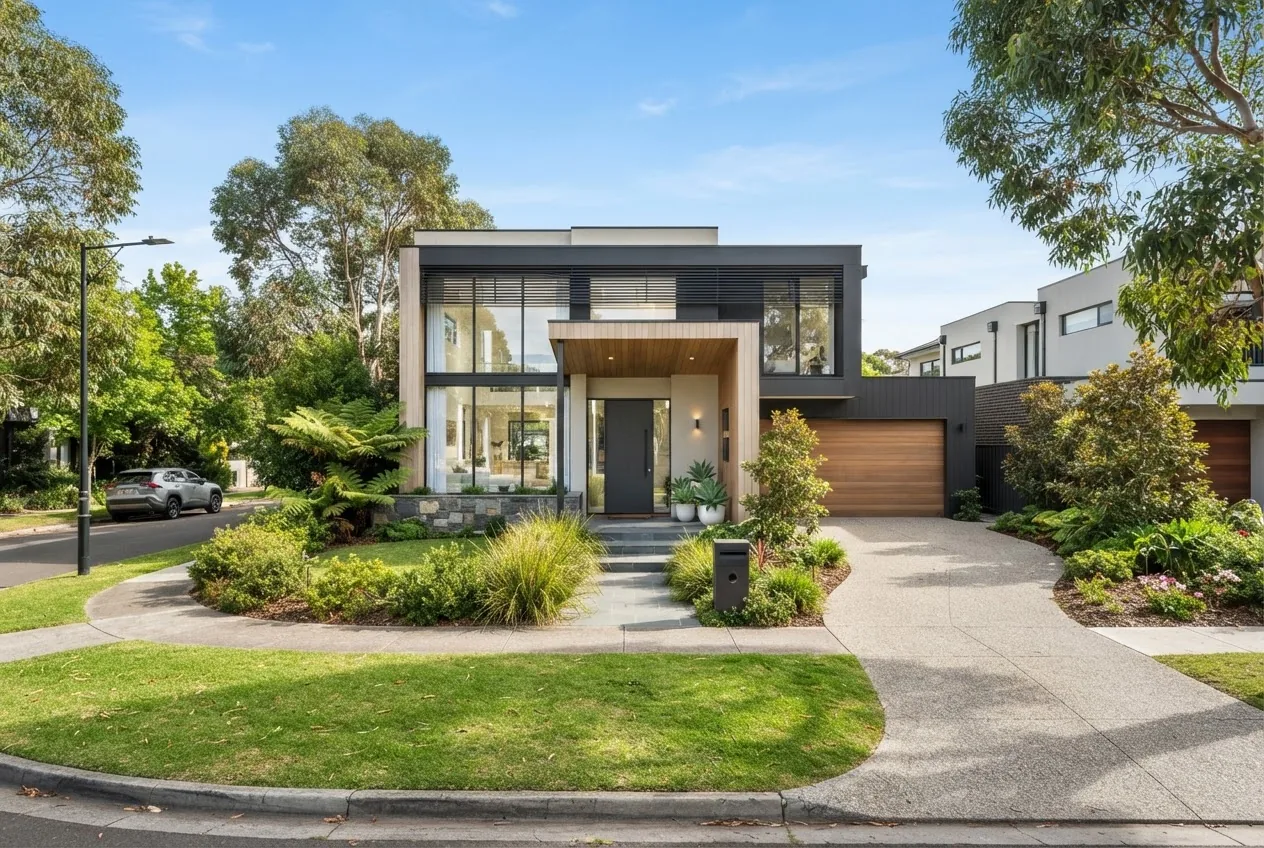
For buyers interested in façade options and street presence, the market offers various frontage designs for new homes across price bands and lot widths.
Popular family layouts include designs featured in our popular three-bedroom designs in Melbourne guide, showing standard inclusions and common upgrade choices.
Transition: next, practical methods to find these homes in active listings and developments.
How to Find New Homes Already Built for Sale in Melbourne
Use a mixed-source search strategy to avoid missing freshly listed move-in ready homes: online portals, developer sales centres and agents can all publish listings at different times.
- Search major real estate portals: Set alerts on domain.com.au and realestate.com.au for keywords “brand new”, “move-in ready”, “new house for sale in Melbourne”, price range and suburbs; expect to receive alerts within 0–2 hours of a new listing going live.
- Monitor developer websites and display homes: Developers sometimes list completed inventory only on their sites before portals. Check developer display home centres on weekends and ask for their finished stock list. For interpreting plans and technical drawings see understanding architectural drawings.
- Work with local agents who specialise in new builds: Agents with developer relationships often receive early notice of completed stock. Provide them a short brief (budget, suburbs, non-negotiables) so they can notify you immediately.
- Use social and community channels: Local estate Facebook groups and Nextdoor posts often show first-hand photos of homes for sale in new estates before formal listings.
- Attend open for inspections and display home tours: Inspect three display homes from the same builder to compare standard inclusions vs upgrades; take photos and a checklist for finishes, appliances and energy fixtures.
- Set up a viewing plan: Schedule blocks of 2–4 viewings per day, allowing 30–60 minutes per property; bring a building inspector (if possible) for shortlisted properties.
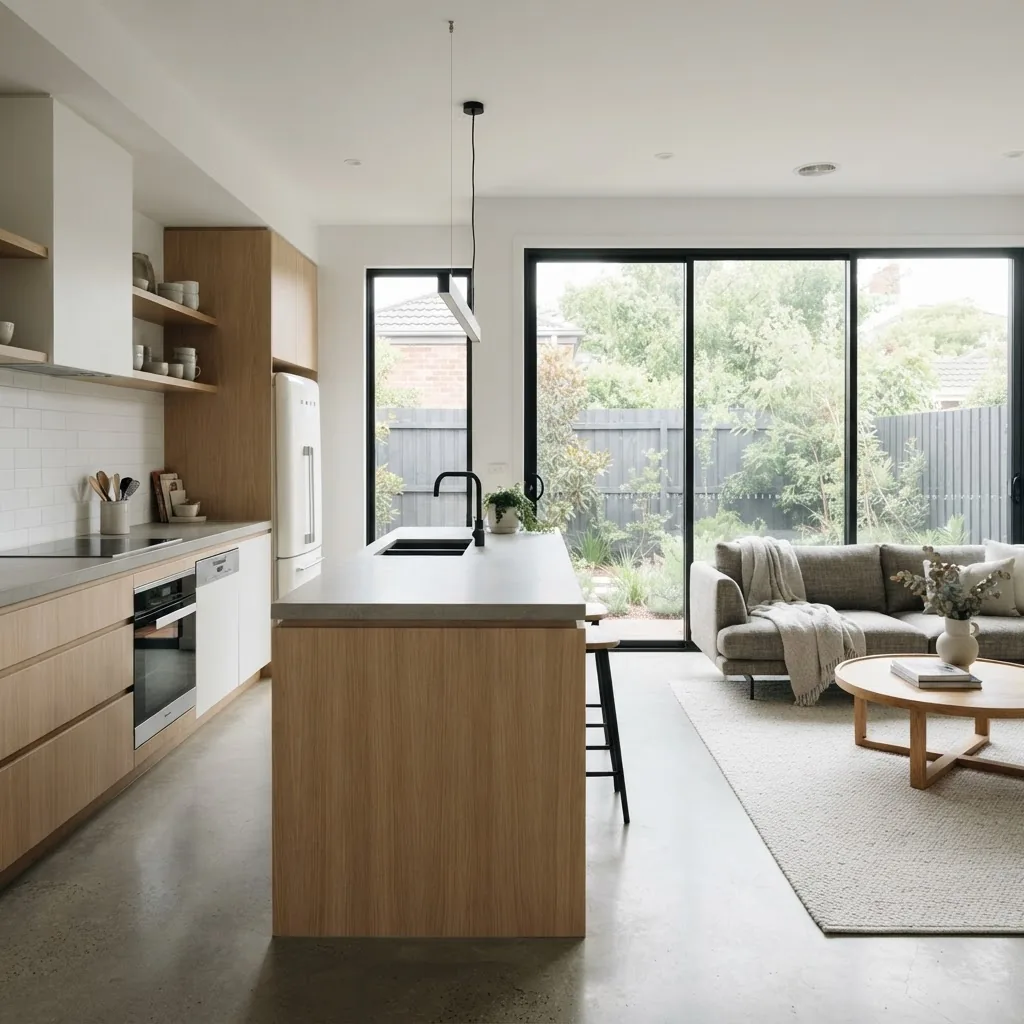
For help comparing interiors and inclusions, see our Display Homes Interior Guide with Style and Layout Options.
Transition: now that you’ve found candidate properties, focus on the evaluation criteria that determine long-term satisfaction and value.
Key Factors to Consider When Buying New Homes Ready to Move In
When evaluating any home inspection new builds, combine visual checks with document verification. Below are the most important items that practically affect safety, cost and resale value.
- Building approvals and certificates: Confirm the Occupancy Permit (or equivalent completion certificate) and that all required permits are lodged with the local council.
- Warranties and insurance: Ask for copies of the builder’s warranty, statutory consumer guarantees, and any home indemnity insurance (usually required for residential builders in Victoria for certain contracts).
- Final council sign-offs: Ensure stormwater drainage, septic or sewer connections, and driveway crossovers are certified by council if relevant.
- Energy efficiency and ratings: Request the energy rating or specifications for insulation, glazing, and heating systems — greater than 6-star is common for modern builds.
- Fixtures and inclusions list: Get a written inclusions schedule that lists all appliances, floor coverings, lighting, and landscaping items included in the sale.
- Landscaping and boundary works: Confirm fence positions, driveway surface and reticulation; incomplete landscaping can add $10k–$25k to move-in costs.
- Noise and neighbouring builds: Inspect at different times (day/evening) for traffic noise and active construction in adjacent lots — noise and temporary access restrictions can affect living quality.
- Builder reputation and post-sales service: Research recent reviews, past project completion times and how builders handle defects; request contact details for recent buyers if available.
- Access to amenities and transport: Measure commute times to work, schools and shops; new estates may project future services — verify realistic timelines with the developer and council planning resources.
- Resale and rental potential: Check comparable sales of recently completed homes within 1–3 km to gauge likely resale values and rental yields.
- Legal encumbrances: Review title for easements, restrictions, and any community title bylaws affecting modifications or rentals.
Practical considerations for multi-storey or specialty configurations:
- For multi-storey homes, check stair dimensions, balustrade compliance and acoustic separation between floors — see our guidance on building requirements for multi-storey homes.
- If the home has an allocated study or granny flat, confirm any separate entries and tenancy restrictions under the title.
If design compliance or site planning is a concern, consult our planning requirements for home designs article for detail on setbacks, overlays and typical council rules.
Transition: the next section breaks down upfront and ongoing costs plus financing options tailored to Melbourne buyers.
Understanding Costs: Pricing, Hidden Fees, and Financing Options
Buying a brand new houses for sale in Melbourne involves purchase price plus several predictable and hidden costs. Below is a compact comparison table of common cost categories and then detailed explanations and funding tips.
| Cost category | Typical range (AUD) | Notes |
|---|---|---|
| Purchase price | $550,000 – $1,800,000+ | Varies by suburb, size and finishes. |
| Stamp duty (Victoria) | $0 – 6% of purchase price | Concessions may apply; see official guidance. |
| Lender and loan fees | $0 – $2,000+ (application & valuation) | Valuation fees can be $300–$600. |
| Conveyancing/legal | $800 – $2,500 | Depends on complexity and searches required. |
| Building inspection | $400 – $900 | Independent pre-settlement inspections advisable. |
| Landscaping & fencing | $8,000 – $30,000 | Often excluded from base price. |
Financing options
- Standard variable home loan or fixed-rate packages — compare interest rates and ongoing fees; rates in 2024 for owner-occupiers typically ranged from 4.5% to 6.5% depending on loan type and LVR.
- First Home Buyer Grants and stamp duty concessions — eligibility varies; check state rules and developer incentives which sometimes include cash or cover stamp duty for qualified buyers.
- Construction/completion loans are rare for fully built homes — most lenders treat a move-in ready house as standard property lending.
- Bridging finance may be needed if selling an existing property; bridging loan costs are usually higher (interest + establishment fees) — plan for 3–6 months overlap where necessary.
For deep dives into how layout affects cost per square metre, see our analysis on cost and layout considerations for new homes and our piece on cost factors for larger home designs.
Compare small-home cost trade-offs with our floor plan essentials for small homes guide when evaluating compact new houses.
External resources for authoritative guidance:
- CoreLogic Australia — market data and property reports (useful for suburb-level trends).
- State Revenue Office Victoria — official stamp duty rates and concessions.
- Master Builders Australia — industry standards and guidance on builders’ practices and insurance/warranty expectations.
Transition: with costs modelled and financing checked, follow the step-by-step buying process tailored to Melbourne transactions.
The Buying Process for New Built Homes in Melbourne
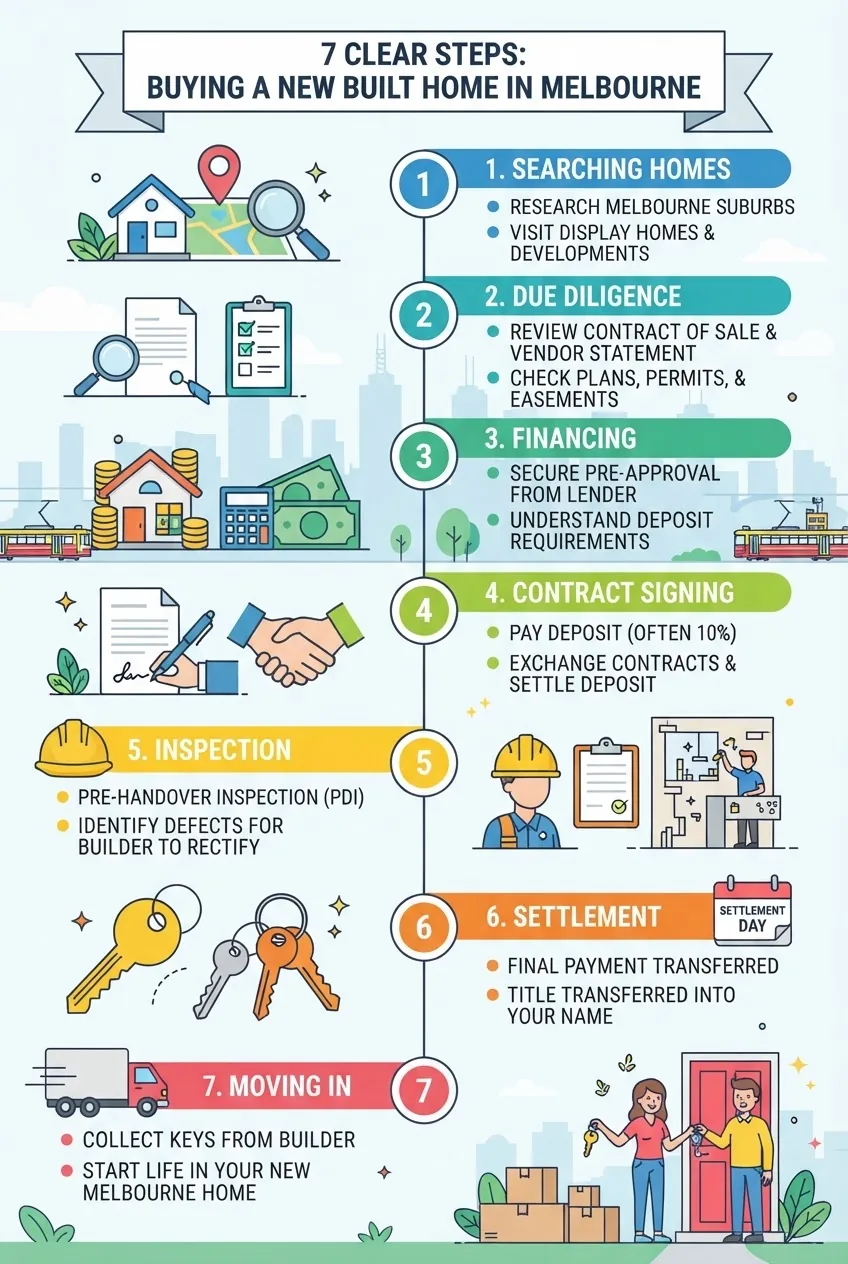
- Step 1 — Shortlist properties and secure pre-approval: after identifying 5–10 suitable move-in ready homes, apply for lender pre-approval. Allow 1–5 business days for conditional pre-approval and get a written estimate of maximum loan amount, LVR and estimated monthly repayments.
- Step 2 — Conduct initial inspections and request documents: inspect the property in person and request: title search, occupancy/certificates, builder warranty documents, inclusions schedule and recent utility connection evidence. Expect vendors to supply these within 2–7 days.
- Step 3 — Arrange an independent building inspection: commission a certified inspector (bookings commonly require 48–72 hours). Inspections cost $400–$900 and should include structural checks, finishes, pest assessment and compliance with Australian standards.
- Step 4 — Get formal loan approval and valuation: submit the contract and inspection report to your lender for formal approval. Lender valuations usually take 3–10 business days; budget for $300–$600.
- Step 5 — Legal review and contract exchange: instruct your conveyancer to review the Section 32/Vendor’s Statement, contract terms and title. Use any cooling-off periods to resolve queries; exchange contracts only when you are satisfied — allow 3–7 days for thorough review.
- Step 6 — Prepare for settlement: coordinate settlement date with vendor, lender and conveyancer; ensure funds for deposit and final settlement (including stamp duty) are organised. Settlement periods commonly range from 14 to 42 days depending on negotiation.
- Step 7 — Pre-settlement inspection and handover: do a final inspection 24–48 hours before settlement to confirm agreed inclusions, that defects have been addressed and keys/access arrangements. Obtain any outstanding compliance certificates at handover.
- Step 8 — Move-in and lodge warranty claims if needed: after settlement, move in and immediately register any builder warranties and home indemnity. If defects appear within warranty periods, lodge claims promptly — keep photographic evidence and dates.
Common timeline example: Week 1 search/shortlist; Week 2 inspections and pre-approval; Week 3 legal review and exchange; Week 4–8 settlement and handover — actual times vary by lender, vendor and complexity.
Transition: before signing anything, use the inspection checklist in the next section to avoid common oversights.
Tips for Inspecting and Evaluating New Homes Already Built
A methodical inspection prevents missed defects and corrects false expectations; the checklist below reflects a typical independent inspection process you can follow.
Pre-inspection preparation
- Bring the inclusions list, a torch, tape measure (at least 5m), camera or phone, and this checklist.
- Allow 45–75 minutes for a detached house; 30–45 for a townhouse.
Inspection checklist
- Exterior: check brickwork/render for cracks, roof tiles or sheets for alignment, gutters and downpipes, drainage fall away from foundation, and driveway paving.
- Interiors: walls and ceilings for hairline cracks, floor leveling, door/trims alignment, window operation and seals; test all power points, light switches and hot water system.
- Kitchen & appliances: run ovens, rangehoods, dishwashers and test soft-close drawers; verify model numbers on invoices against contract inclusions.
- Plumbing & drainage: flush toilets, run taps for pressure and temperature, inspect under sinks for leaks, verify stormwater outlets.
- Pest inspection: order or perform a termite risk inspection, particularly in timber-framed builds or where bushland is nearby; cost $150–$350 if separate from main inspection.
- Energy systems: check hot water system type (electric, gas, solar), meter locations and any installed solar PV; verify inverter model and warranty.
- Compliance & paperwork: confirm occupancy certificates, building approvals, BASIX certificates (for energy/water performance where applicable), and any warranties are present.
- Minor defects: make a list of paint chips, grout issues, silicone sealant gaps and loose fittings; request a rectification schedule prior to settlement.
If major defects are found, negotiate remediation or delay settlement until fixed; for minor defects, require a dated defects list in the contract to be completed within an agreed 14–30 day window after handover.
Transition: while inspections focus on the physical home, the legal and contractual framework governs your protections; the next section covers essential legal tips.
Legal and Contractual Considerations
Victoria has specific rules for property contracts, cooling-off periods and title transfers. Always instruct a local conveyancer; their role is to manage searches, review contracts and ensure legal compliance during settlement.
Key legal tips:
- Cooling-off periods: Victoria offers a three-business-day cooling-off period for most residential purchases unless the property is bought at auction or the buyer waives the period. Use this time for final checks.
- Title searches and easements: your conveyancer will run a title search to identify easements (drainage, power lines) and restrictive covenants that may limit landscaping or outbuildings.
- Condition precedents: include finance approval as a condition if your loan is not yet unconditional — set a precise deadline (e.g., 14 days) to avoid ambiguity.
- Dispute resolution: contracts commonly include a dispute resolution clause; your conveyancer should explain processes and timelines for formal disputes.
- Registration and transfer: settlement involves official transfer of title and registration; your conveyancer will lodge necessary paperwork with Land Use Victoria and manage funds exchange.
- Statutory warranties and consumer rights: reference Victorian building standards and statutory warranties; if unresolved, disputes can be taken to the Victorian Civil and Administrative Tribunal (VCAT).
For official guidance on stamp duty and other state-specific regulations consult the State Revenue Office: State Revenue Office Victoria. For legal questions specific to your contract, seek qualified conveyancing counsel; this article does not replace legal advice.
Transition: now compare new-built homes and established homes across investment and lifestyle metrics.
Comparing New Built Homes with Established Properties in Melbourne
Decision factors between new built and established properties often boil down to maintenance, customization, neighbourhood maturity and investment profile.
| Factor | New Built Homes | Established Homes |
|---|---|---|
| Maintenance | Lower in first 5–10 years | Potentially higher due to older systems |
| Customization | Limited after build; pre-sale upgrades possible | Higher potential for renovation and value-adding |
| Neighbourhood maturity | Developing; services may lag 3–7 years | Established amenities and transport |
| Resale value | Can be strong if suburb grows; risk if many new homes released | Often steadier due to location and land value |
For buyers focused on smaller footprints, our floor plan essentials for small homes offers targeted advice on maximizing space and resale for compact new builds. For layout-focused families, refer to our three-bedroom plans article linked in the market overview.
Transition: after purchase, these practical steps speed your move-in and protect your warranty rights.
After Purchase: Moving In and Settling into Your New Melbourne Home
Once settlement is complete, these immediate actions reduce stress and safeguard your property investment.
- Connect utilities: arrange electricity, gas, water and internet within 1–3 business days to ensure services start by move-in.
- Register warranties: lodge builder warranties, appliance warranties and any home indemnity insurance within 7–14 days of settlement.
- Complete final snags list: submit any defect claims in writing within the builder’s specified period — photograph issues and include dates.
- Council services and rates: notify your local council of the change of ownership and set up rates payments — allow 5–10 business days for processing.
- Landscaping maintenance plan: if landscaping was included, confirm maintenance guarantees; if not, schedule landscaper quotes within 2–4 weeks.
Transition: before you sign, review common mistakes that buyers make when purchasing new-built homes.
Common mistakes and how to avoid them
I once recommended a move-in ready home to a client who trusted the display home finishes — after settlement they discovered significant appliance substitutions and missing landscaping. From experience, avoid these failures:
- I failed to insist on the written inclusions schedule — always get model numbers and brands in writing to avoid substitutions.
- I assumed occupancy certificates were on-hand without checking council records — always verify certificates before exchange.
- I underestimated landscaping costs — budget at least $12k for a modest backyard and front landscaping on standard lots if not included.
Compact checklist before you exchange contracts
- Pre-approval from lender obtained and formal approval timeline agreed.
- Independent building inspection completed and reports reviewed.
- Copy of Occupancy Permit and compliance certificates received.
- Inclusions schedule, appliance models and warranty documents attached to the contract.
- Conveyancer has completed title and easement searches and reviewed contract conditions.
- Settlement period and settlement funds confirmed, including stamp duty estimates.
When to call in a professional
- Call a conveyancer immediately if the vendor cannot produce occupancy or compliance certificates.
- Call a certified building inspector if structural concerns, visible cracks or water ingress are suspected.
- Call a financial adviser or mortgage broker if your loan approval is conditional or bridging finance is required.
Transition: final thoughts and practical next steps to start your search with confidence.
Conclusion and Final Buying Advice
Summary: buying brand new homes for sale in Melbourne can deliver immediate lifestyle benefits, modern efficiency and lower short-term maintenance. Balance these against potential premiums, neighbourhood maturity and hidden upgrade costs. Start with lender pre-approval, an independent inspection and a conveyancer review before exchanging. Next steps: set portal alerts, contact a specialist agent in your chosen suburb, and book inspections for shortlisted homes this week.
If you’re ready to begin, prepare your pre-approval documents, select three target suburbs and book a viewing with a trusted local agent within the next 7 days.